
MLK Award Winner Adanna Okiwelu Finds Ways to ‘Build Bridges That Need to be Built’

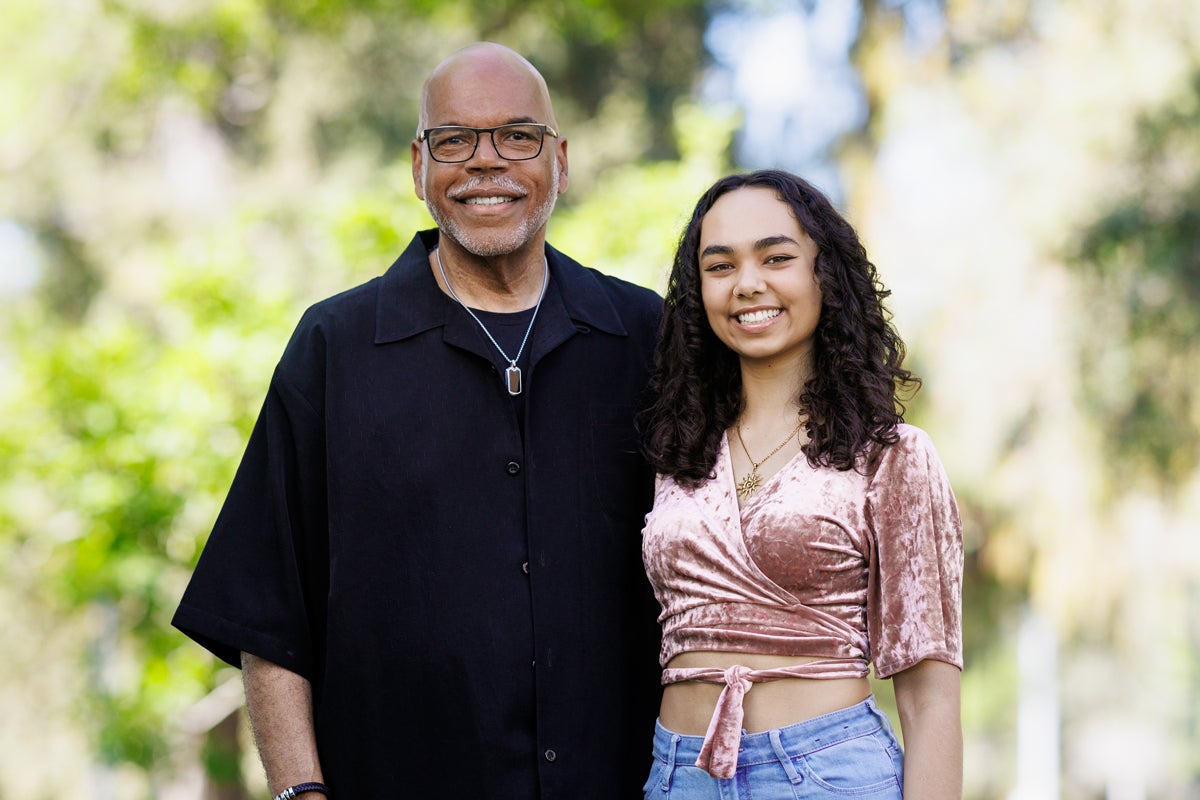
At the 10th annual MLK Jr. Legacy event in January, third-year economics student and Black Student Union (BSU) board member Adanna Okiwelu co-accepted the MLK Legacy Award. She was honored alongside Preston Allen, retired associate vice president for Cal Poly's Student Affairs Division and executive director of Cal Poly University Housing, for their work to strengthen Cal Poly and the broader community.
Okiwelu, who is concentrating in accounting and minoring in statistics, has flexed her leadership skills across campus, conducted research on alumni career paths as a BEACoN research scholar and studied abroad in Spain.
She sat down with Cal Poly News to talk about the honor and her knack for making fruitful connections on and off campus. The conversation below has been edited and condensed for clarity.
How did it feel to win the MLK Award?
I was really shocked and overwhelmed with a lot of joy and excitement. I also felt very reflective in that moment when my mentor Christina Sholars Ortiz asked me to come up if I wanted to share some words. I just started crying. After I had recognized that it was me, I got to stand up and see this beautiful room of community members that I'd been able to get closer with through the Black Student Union this year. It was truly incredible. To be recognized for something that was so close to my heart really meant so much to me.
Your nomination for the MLK Award noted that you created a new board position for BSU. How did that happen?
Something that I'm really passionate about is connecting people, and the donor relations chair position is meant to fill in the gaps to connect community members and our students. It really started last year with a few conversations between several board members and Preston Allen around how we could create sustainable financial solutions for the Black Student Union to support all the amazing initiatives that we want to take on. There were community members that wanted to connect with us but didn't know where to start. I really wanted to be the one to help.
For example, during Black History Month, we have Black Love, which is our annual formal event. Finding a venue for Black Love every year has been one of the most expensive and difficult things for us to do. Thanks to Preston, I was able to connect with pastors James and Niecy of Agape Church. They were like, “How can we help you? Do you ever want to come study here, or have an event here, or do a fundraiser here?” This year, they hosted Black Love for us for free. To have a beautiful facility that's off campus — and is run by Black pastors — to see it all come together was incredible.
How have your identities informed how you approach leadership?
I am a mixed-race person, a woman and also part of the queer community. Being a part of so many different communities, but also kind of in between worlds, has always been a little bit difficult because I never felt like I fully belonged anywhere. But at the same time, I belonged in a bunch of different places. I've realized how powerful that perspective is and how necessary it is as well to be able to understand different perspectives, be able to listen and build bridges that need to be built.
What other leadership experiences have helped shape your Cal Poly experience?
Women in Business (WIB) was one of the biggest reasons I decided to come to Cal Poly. As a high school student, I got an invitation to come to Cal Poly through Wonder with WIB, and I got to meet so many incredible people. Fast forward to when I came to Cal Poly, I got really involved with everything under the sun, including the Women's Leadership Academy, which is a business professionalism class. I applied for the director of group development position, which led to doing a lot of event planning for community building activities. It was cool to, again, connect people and build a more inclusive environment.
I got involved with the Multicultural Business Program (MBP) in my first year as well. That was another space where I really felt like I belonged. Having that space was very important to me. I had a mentor in my first year in that program, Lisette, who always reached out to me and was really helpful when I was deciding what concentration to pick. Having a mentor was one of the biggest things that led me to apply to be an MBP intern — and now, I have mentees and getting to meet with them is one of the biggest things that I look forward to at work.
So much of what you have led and experienced involved mentorship. What have you learned while serving as a mentor to other students?
One of the biggest things that I have really learned is just how far I've come since my first year. I think another thing is how valuable it is to be a trustworthy listening ear who provides a sense of familiarity. I think that's one of the things that's easily overlooked.
In the Multicultural Business Program, we serve a variety of different students and often a lot of them have questions like, “What is the diversity like at Cal Poly? What is it like on a daily basis?” They come in knowing white students are the largest racial group at Cal Poly, and they know that the business major is traditionally male dominated. I also had questions about all those things when I first came to Cal Poly.
There are so many struggles that we face together, and even if we don't all face the same thing, we're all struggling under the same systems of oppression. We realize how important it is — especially right now when times are so heavy and there's so much going on politically and socially — to find spaces to take care of each other, especially people of color.
Want more Learn by Doing stories in your life? Sign up for our monthly newsletter, the Cal Poly News Recap!


