
Cal Poly Float Wins Sweepstakes Award at 2026 Rose Parade

Cal Poly universities’ “Jungle Jumpstart” rainforest float that showed how nature and technology work together to create a better world received the Sweepstakes Award at the 137th Rose Parade® held on a rainy New Year’s Day.
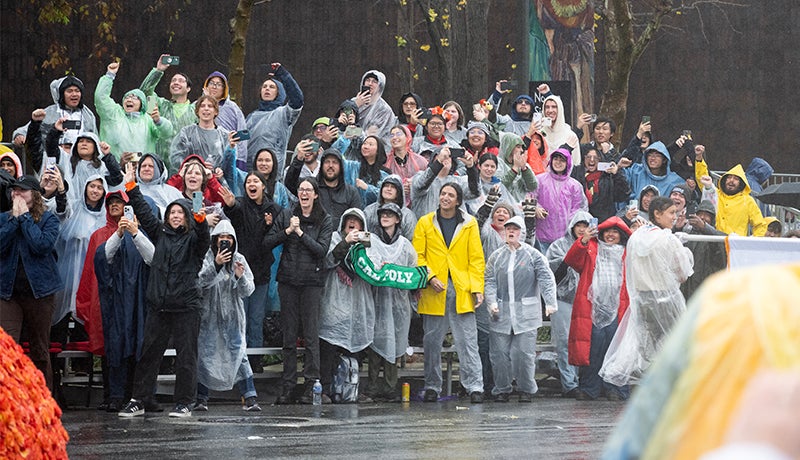
The prestigious honor — a first in the schools’ nearly eight decades in the parade — honors the most beautiful float overall and is typically won by larger, commercially-built floats or major organizations, not by self-built entries that include the California State University campuses.
“It’s really remarkable to win this award and celebrate it, especially on this year’s theme,” Cal Poly Rose Float President Aubrey Goings said after the awards were announced prior to the parade. “We’re really just ecstatic, especially because this year’s theme — ‘The Magic in Teamwork’ — and us winning this is really celebrating our teamwork how we get together and make everything from scratch, learning from each other.
“What sets us apart from some of the other parade floats is how we built this truly from our hearts and how we are telling our own story in the float through the animals, working together on the robot — just like us, with students from two universities and multiple disciplines working together to support each other and make something beautiful.”
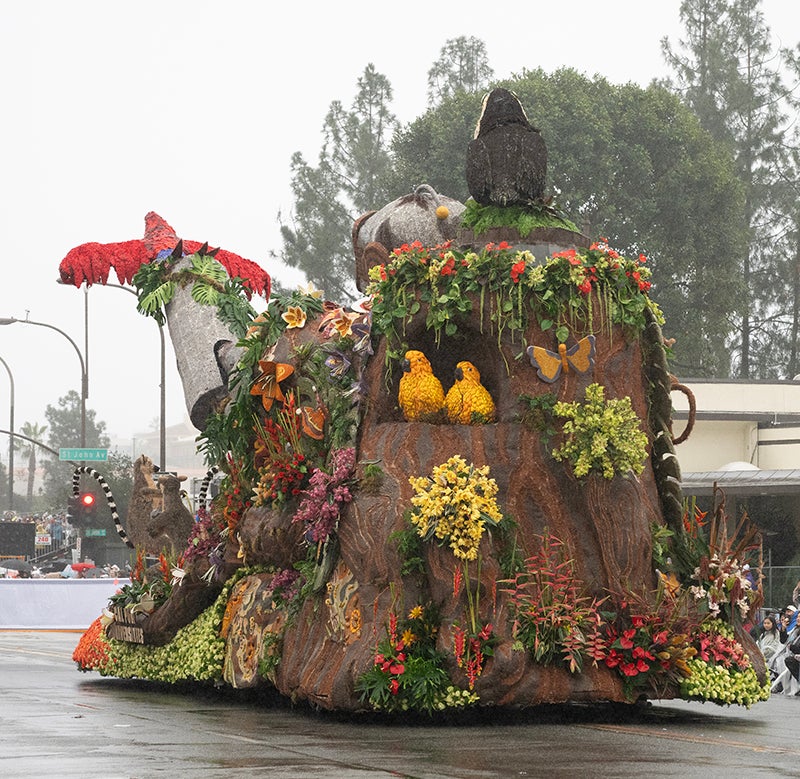
Measuring 53 feet long, 25 feet high and 18 feet wide, “Jungle Jumpstart,” explores the 2026 parade theme by showcasing the dynamics of a unique partnership through the story of rainforest denizens restoring a 40-foot robot friend.
The only parade float designed and built completely by students not only exudes teamwork in the way it looks but also the process by which it is constructed. Cal Poly universities’ Rose Float is a joint effort between students at Cal Poly and at California State Polytechnic University in Pomona.
The partnership reaches back nearly 80 years when the Pomona school was first a satellite campus of Cal Poly. Their efforts to produce a rolling floral bouquet to the world is among the highest-profile student examples of Cal Poly’s hands-on, Learn by Doing approach.
Student float leaders — about 30 from each campus — came together in San Luis Obispo early in 2025 to discuss ideas. They were excited for the story of the “old, rundown robot in the jungle, and the forest animals bringing their friend back to life by incorporating what they know best — the jungle,” said Goings, a fourth-year architectural major and four-time parade veteran.
The winning concept was submitted by Zander DeRenard, a Cal Poly Pomona mechanical engineering senior and two-year veteran of the team.
The 2026 Rose Parade theme resonated with the leadership team and the story that “Jungle Jumpstart” shares.
The Cal Poly universities’ float annually demonstrates that by working together on outcomes “much richer than we can ever experience as individuals,” explained Mark Leavens, this year’s Tournament of Roses president.
“We really felt that spoke to us on a personal level,” Goings added. “We work across 250 miles and two campuses to create something spectacular. All of our students come from so many different backgrounds and are learning and teaching each other how to do these float tasks — and all of this collaboration is who we are.”
Each year Cal Poly Rose Float students work together to grow their skills and innovate by fine-tuning past float successes. “Jungle Jumpstart” shows these ambitions in the story and its animations.
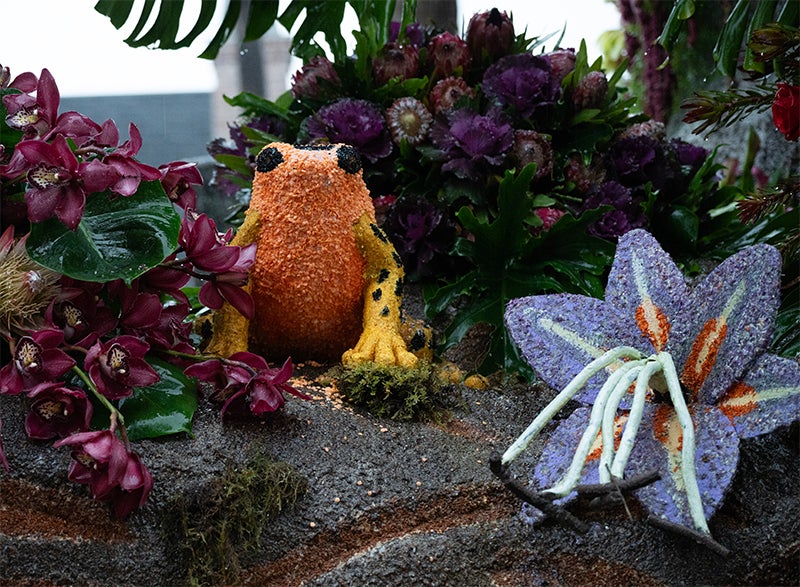
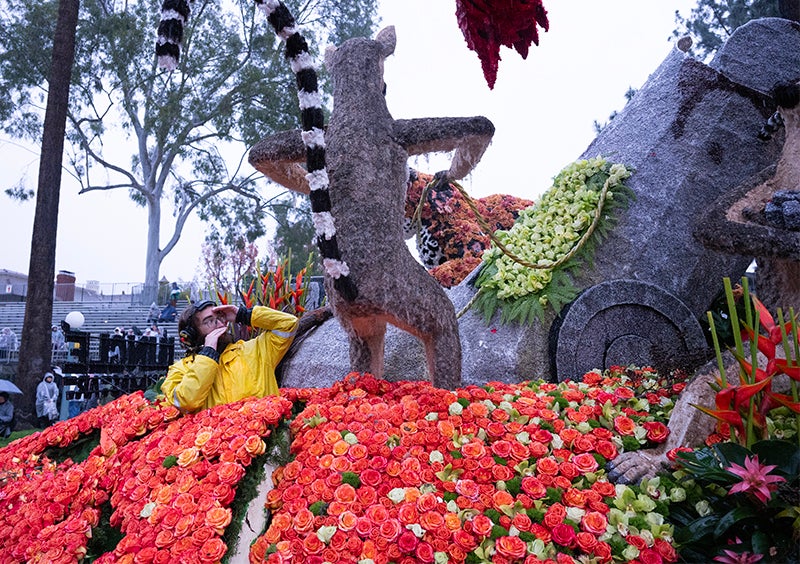
Wires spark as a robot slumbering in a dense, jungle undergrowth blinks back to life, lifting its head to observe its new surroundings. Two ring-tailed lemurs work to reconnect a broken wire in the robot’s leg, while a sleepy jaguar perches on the other, chewing a vine, tail dancing blissfully. A tree frog positions a wood panel on the robot’s right arm, as the supervising toucan rotates its head, carefully inspecting the progress. The restored robot’s eyes, made of 2-foot digital screens, stare at a brightly colored macaw held in its mechanical hand, lifting the bird as it readies to fly.
To lift the bird to the sky, multiple cylinders move in harmony to support the 1,600-pound weight of the robot’s arm, macaw’s systems and decorations.
“We’re using a neoprene jacket over the bird in order to have smoother motion as it’s flapping wings up and down,” Goings said. “A lot of what we’ve been doing is building off what we’ve learned in the last few years. We’re advancing our concealment department that focuses on creating smoother visual looks between a moving element and the decorations that go on top.”
The students show further innovation through an assortment of electronic lighting to show the spark that brings the robot and story to life.
“We got some LED strips and put them in tubes that diffuse the light,” Goings said. “We used this throughout the robot’s body to show how the electricity is running through it and how it actually is coming alive besides just the movement of the robot.”
This scene proved to be more difficult than previous years’ floats, because of the density of harder-to-acquire tropical plants; however, the students solved this by being creative and collaborating with the community.
The robot was covered in a blend of blue corn grits, onion seeds and rice accented with patches of High Magic roses that portray the robot’s rust in a beautiful way. Jungle animal fur was brought to life through bronze chrysanthemums and cattails, while orange and lemon peels created vibrant feathers on a pair of birds (made of lemons grown at Cal Poly and oranges harvested at the Pomona campus).
Layers of foliage built from overlapping varieties of pothos, ferns and philodendrons formed the dense, lively undergrowth. Vibrant heliconias (lobster-claws) and ginger lilies emerge from this greenery, adding depth and dimension. Throughout the float, combinations of dry and fresh materials brought out the textures of the jungle, blending natural vibrancy with the metallic texture of the robot.
“Jungle Jumpstart” included some Easter eggs: The fallen, mechanical chest panel of the robot sports the universities’ Rose Float logo. Additionally, on the robot’s leg there’s a CPRF 77 (Cal Poly Rose Float) — to show this is the universities’ 77th float. The team also honored Tim Okuma, a 1974 Cal Poly Pomona alumnus who died in May, with his name placed on a large, fabricated flower on the float. The 74-year-old was a dedicated supporter of the Rose Float program, especially during Deco Week in Pasadena, where he was known to greet students, alumni and Rose Float friends with joy and enthusiasm.
A team of four from both schools served as the unseen float operators. These included driver Sean Hanna and engine operator Benjamin Phillips from the Pomona university. From Cal Poly were: driver observer Ryan Newton, a fifth-year industrial engineering and physics major, and Enzo Roberto, a computer engineering junior and Eagle Scout, who handled animation duties during the 5-1/2-mile parade route.
Since 1949, the schools have produced scores of award-winning entries, but 2026 marks Cal Poly universities’ most-successful appearance in the annual event. “To our knowledge, a self-built float has never won this award before — at least we haven’t,” Goings said.
The first Cal Poly first float was hastily assembled in three months for $258 (about $3,400 in today’s dollars) in the waning days of 1948. Since receiving its first Award of Merit on New Year’s Day 1949, entries have grown in size and sophistication. And along the way they’ve earned 64 awards, including the 2025 Leishman Public Spirit Award, which recognizes the most outstanding floral presentation from a non-commercial participant.
“Every year we’re just really excited to prove ourselves and show what we can do,” Goings said. “Everyone went an extra step beyond what we’re comfortable with having a float that’s so large. We’re going to have to decorate more. We’re going to have to build more. And so by reaching these new bounds, we’re placing more complications on ourselves. But we are always excited to solve these problems to show that we can do something very spectacular and awe-inspiring.”
Want more Learn by Doing stories in your life? Sign up for our monthly newsletter, the Cal Poly News Recap!


